Rayo
The Vampire Prince’s BrideRayo’s brief appearance turns a seemingly administrative visit into a revelation of organized human trafficking. As the T'shav representative sent by the Ruziers Corporation, he arrives aboard Tom’s ship with information about Zon, a commercial mandate to supervise the shipment, and an openly exploitative understanding of human bodies. His encounter with Sara and Tom brings the hidden economy surrounding the humans into the open, while his death forces Tom and Sara into immediate, irreversible action.
Identity and Introduction
Rayo is introduced as the leader of a mixed-species group that boards Tom’s ship on behalf of the Ruziers Corporation. He is a T'shav wearing a traditional var'ki skirt, with vivid black tattoos covering his chest and arms. The tattoos depict swirls, spikes, skulls, and a flower positioned over his heart, giving him a visually marked identity before he has explained his purpose. His physical presentation combines cultural specificity with menace, and Sara’s reaction to his gaze establishes that he is not merely a courier or bureaucrat: she experiences his attention as invasive and immediately moves closer to Tom.
Rayo greets Tom as “Bond” and refers to Tom’s recent encounter with the USC as a matter already known to the corporation. His familiarity indicates that he has access to operational information about Tom’s movements and that the Ruziers Corporation is monitoring the failed or deceptive escape. Tom responds by pretending that the USC incident was trivial and claiming that he discovered the tracking device planted on his ship. Rayo does not openly challenge the story at first, but his scrutiny suggests that the exchange is an assessment of Tom’s loyalty rather than a casual professional visit.
Mission and Commercial Knowledge
Rayo explains that he has come to warn Tom that Zon has learned about the shipment and is sending someone to collect it. Zon is widely known as a powerful T'shav warrior who commands a large fleet and exercises influence over numerous colonies; he is also associated with the Human Rights movement. The information changes Tom’s calculation. Tom does not want to confront Zon’s people and initially decides that the safest course is to turn his ship around and leave.
Rayo prevents that retreat by stating that the Ruziers Corporation will accompany Tom to the shipment site and back. According to him, the corporation no longer considers stealth viable, so his party has been assigned to guarantee Tom’s safe arrival and return. He also reveals that Tom’s retainer has been tripled. The increased payment, combined with the armed escort, shows that the shipment is unusually valuable and that Ruziers fears losing it to Zon’s intervention. Rayo therefore functions as both messenger and pressure mechanism: his warning presents the danger, while the escort and enlarged payment bind Tom more tightly to the mission.
The decisive revelation comes when Rayo answers the question of why humans matter so much to the corporation. He says that humans are not classified as a sentient species and possess universal DNA, making the shipment worth more than Sara can imagine. He distinguishes between the sexes according to their commercial uses: males can be sold to laboratories or private collectors, while females can be sold under the population trade act. The legal language disguises an enslavement system in which women are treated as reproductive resources. Rayo’s explanation converts the abstract promise of a human sanctuary into evidence of a trafficking operation and makes the corporation’s interest in the shipment brutally legible.
Encounter with Sara and Tom
Rayo identifies Sara as the female accompanying Tom and looks over her in a way that makes her physically recoil. Tom introduces her as “Nelly,” claiming that he picked her up to help him through his musth and insisting that she is of no consequence to Rayo. The performance is meant to conceal Sara’s importance and present her as a disposable girl-toy, but Tom’s dangerous tone reveals that the role does not describe his actual attitude toward her. His arm tightens around her when Rayo examines her, and his possessiveness becomes visible even while he attempts to preserve his cover.
Rayo’s conduct exposes the violence embedded in the commercial system he represents. He treats Sara first as an object to be classified and then as merchandise whose value can be calculated. When Tom warns him not to provoke him during musth, Rayo backs away briefly, but he continues testing the situation by pointing out that Sara is human. Tom confirms that he knows her identity and tells Rayo that it is none of his business. Rayo then escalates from insinuation to an explicit threat: he says that his group could kill Tom and take Sara.
The threat also connects Rayo’s suspicions to Tom’s background. Rayo says that he thought of Tom when he heard that Zon’s son had been sent after a shipment of humans, and he suggests that Tom’s conveniently timed escape from Flanard was suspicious. He is therefore close to identifying Tom’s position or deception. Rayo’s unfinished accusation leaves little room for negotiation: he has recognized Sara’s value, questioned Tom’s story, and announced that force can replace the corporation’s contractual arrangement.
Death and Immediate Consequences
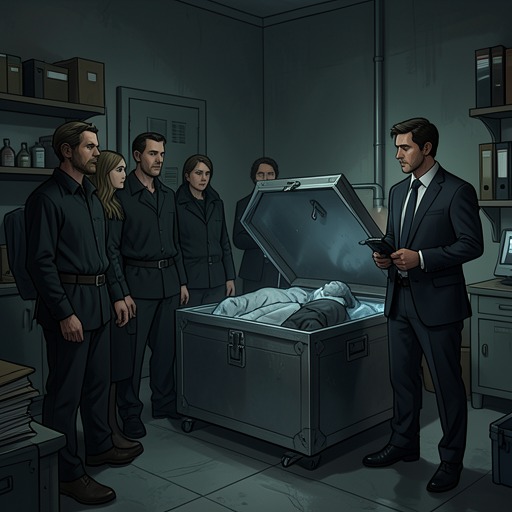
Rayo never finishes his accusation. Tom draws a dagger and lunges, driving the blade through Rayo’s collar before the T'shav can react. The killing is not a distant or procedural defeat; it is a sudden close-range response to the threat against Sara and to the danger that Rayo’s knowledge poses to Tom’s larger mission. Tom kills another member of the visiting crew before two gunshots bring down two more. Sara then appears in the bedroom doorway holding the gun she had found on the nightstand, making her an active participant in the defense rather than a protected bystander.
The last surviving alien turns toward Sara, but Tom throws his knife into the alien’s chest, and Sara finishes the attack with a gunshot. The division of violence between them marks a change in the scene’s power dynamic. Rayo had expected a compliant female and a potentially manageable operative; instead, the pair coordinate under pressure and eliminate the entire visiting party. Tom immediately turns to the controls and fires on Rayo’s ship without first completing a life-form scan, accepting the risk that someone might still be aboard because waiting could allow the vessel to destroy his own ship.
Rayo’s death consequently destroys the possibility of a controlled corporate escort and accelerates Tom and Sara’s flight from the Ruziers operation. It also removes the person who carried the clearest verbal evidence of the corporation’s plan to sell human women under the population trade act. His final function in the plot is therefore double: he reveals the system’s logic in plain commercial terms, then becomes one of its casualties when that logic is directed at Sara.
Narrative Significance
Rayo is a compact but consequential figure whose dialogue supplies the economic explanation behind the human shipment. His characterization is built through the contrast between official language and physical predation. He speaks of sentience classifications, universal DNA, retainers, escorts, and legal population trade, yet those terms conceal laboratories, private collections, and the sale of women as reproductive commodities. The polished vocabulary does not soften the violence; it demonstrates how institutions make exploitation appear administratively ordinary.
His encounter also intensifies the uncertainty surrounding Tom. Rayo suspects that Tom’s escape was staged or compromised, and his reference to Zon’s son places Tom inside a wider network of allegiance and surveillance. Tom must maintain his cover while resisting the musth-driven impulse to attack, but Rayo’s threat to take Sara collapses that restraint. The confrontation thus converts suspicion into action and forces Tom to reveal, through violence, where his loyalties lie.
Rayo’s narrative role is brief, but his disclosure changes the meaning of the entire shipment. Before he speaks, the humans might still be understood as potential refugees in need of a sanctuary. After his explanation, the central danger is unmistakable: the Ruziers Corporation intends to monetize their biology and especially the reproductive capacity attributed to the women. Rayo embodies that system’s gaze, reducing people to categories and prices. His death does not undo the system, but it ends his immediate power over Sara and leaves Tom and Sara moving forward with knowledge that makes neutrality impossible.